Frequently asked questions about chiropractic in Estepona
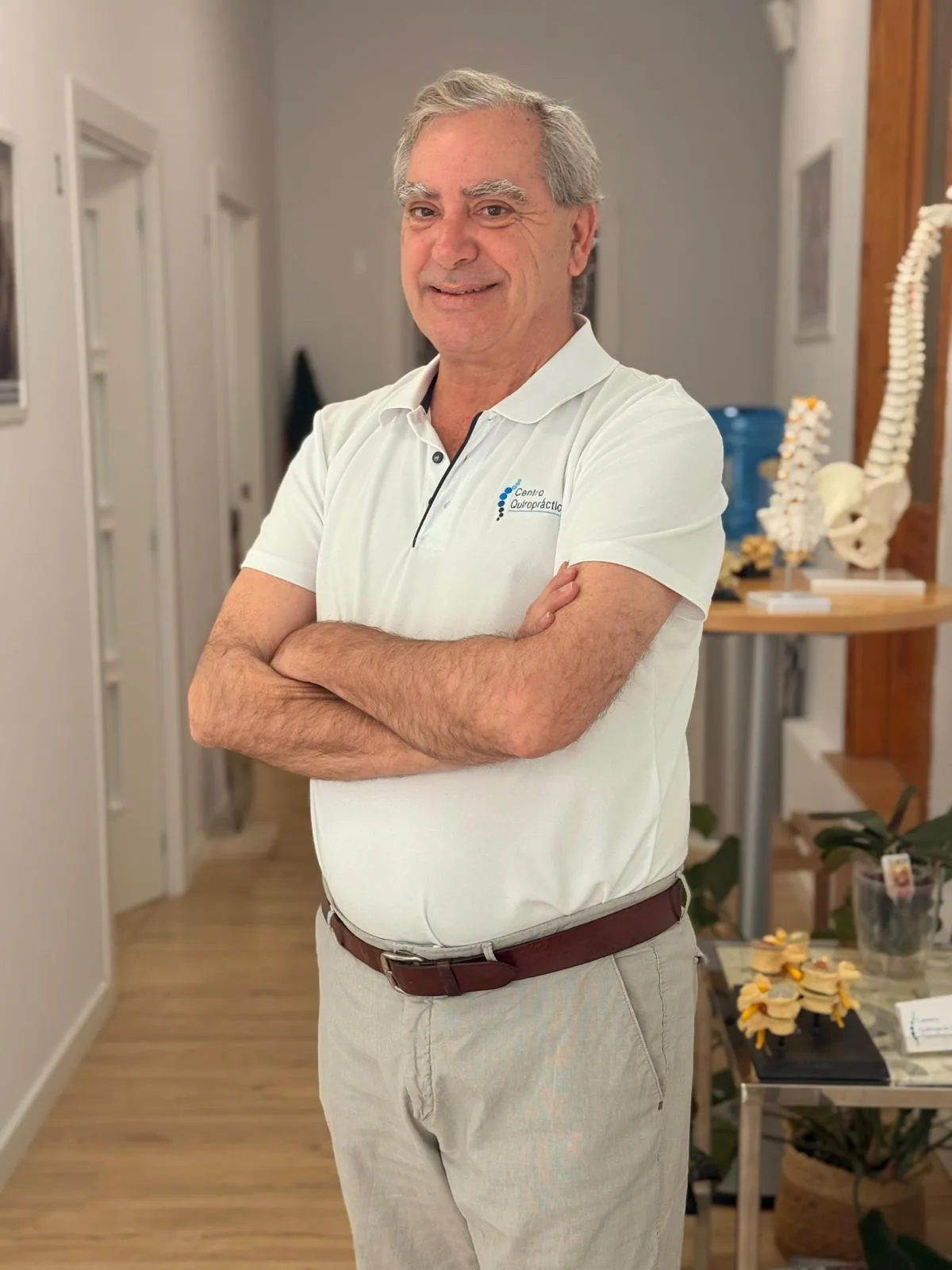
Answered by Dr. José María Puig Sobrino
Doctor of Chiropractic (D.C.) · Cleveland University · AEQ #1036
We answer the most common questions about chiropractic and our centre in Estepona. If your question is not here, please do get in touch.
About chiropractic
Chiropractic is a discipline focused on the care of the spine and the nervous system, recognised as a healthcare profession by the WHO in over 90 countries, though it is not yet regulated as a registered healthcare profession in Spain. Through specific vertebral adjustments, the chiropractor helps correct dysfunctions that interfere with nerve communication, supporting the body's natural ability to self-regulate.
Dr. José María Puig Sobrino is a Doctor of Chiropractic (D.C.) and a member of the Spanish Chiropractic Association (AEQ, registered member #1036). He has more than a decade of experience and is skilled in 6 specialised chiropractic techniques.
A first visit to the chiropractor lasts 45 to 60 minutes and follows five steps: (1) detailed case history, (2) physical examination and specific functional tests, (3) clear explanation of the findings, (4) first chiropractic adjustment if appropriate, and (5) a personalised care plan organised by phases. At Centro Quiropráctico Puig in Estepona, Dr. Puig (Doctor of Chiropractic, AEQ #1036) selects the most suitable technique (SOT, Gonstead, Cox Flexion-Distraction, Diversified, Thompson or Activator Method) after the functional assessment. No technique is applied without your informed consent, and you will get a clear explanation of what is happening at every stage of the visit.
No, the chiropractic adjustment does not hurt. It is a precise manual movement, of high velocity and low amplitude, applied to a specific spinal joint. The "click" sound you may hear is cavitation: small gas bubbles (CO₂) released inside the joint capsule, a completely harmless phenomenon unrelated to bone. Most patients feel an immediate sense of relief after the adjustment. For older adults, expectant mothers, children or sensitive patients, Dr. Puig uses low-force techniques such as Activator Method (a handheld instrument) or SOT (positional blocks), which adjust without any audible click or manual thrust.
Practically anyone, from newborns to older adults. At Centro Quiropráctico Puig in Estepona we look after babies, children, teenagers, adults, expectant mothers, athletes and older adults. The techniques are always adapted to the age and condition of each patient.
No, you do not need a medical referral to see a chiropractor. You can come directly to Centro Quiropráctico Puig in Estepona by booking an appointment on 952 791 996. Dr. Puig will carry out his own full chiropractic assessment.
The main difference is the approach: the chiropractor focuses on the biomechanical cause of dysfunction (the spine and nervous system relationship) and uses specific vertebral adjustments of high velocity and low amplitude. The physiotherapist works on the muscles, movement and functional rehabilitation through therapeutic exercise, manual therapy and electrotherapy. Training also differs: chiropractors complete a 5-6 year university degree accredited by the European Council on Chiropractic Education (ECCE); physiotherapists complete a 4-year Physiotherapy degree regulated in Spain. When to choose one or the other? Chiropractic care is usually the first choice when correcting vertebral joint dysfunctions; physiotherapy is the right option for post-injury, post-surgical or sports rehabilitation. Both disciplines are complementary and often work together.
Although both use manual techniques, the chiropractor focuses specifically on the spine and nervous system, using high-velocity, low-amplitude vertebral adjustments. The osteopath takes a broader view of the musculoskeletal system. The university training of a chiropractor is 5 to 6 specific years.
Chiropractic is legal in Spain, though it is not yet regulated as a registered healthcare profession. The WHO recognises it in over 90 countries. The Spanish Chiropractic Association (AEQ), founded in 1986, brings together only professionals with university qualifications recognised by the European Council on Chiropractic Education. Dr. Puig is an AEQ member (#1036).
A vertebral subluxation is a misalignment or dysfunction of a vertebra that interferes with the way the nervous system works. It can be caused by physical, chemical or emotional stress. The chiropractor detects and corrects subluxations through specific adjustments.
Cracking your own back is not the same as a chiropractic adjustment. Self-cracking moves vertebrae that already have mobility, not the ones that actually need it. The chiropractic adjustment is a specific movement, aimed at the exact vertebra in the precise direction.
Safety and contraindications
Chiropractic is one of the manual therapies with the best safety profile when carried out by qualified professionals. Dr. Puig is a Doctor of Chiropractic and an AEQ member (#1036), which guarantees his university training and professionalism.
Prices and appointments
The first visit at Centro Quiropráctico Puig includes a full case history, examination and, if appropriate, the first adjustment, lasting roughly 45 to 60 minutes. Current fees are confirmed by phone on +34 952 791 996, as pricing varies by session type and personalised care plan. Follow-up visits (15 to 30 minutes) are priced differently from the initial consultation. Dr. José María Puig, Doctor of Chiropractic (D.C.) and member of the Spanish Chiropractic Association (AEQ #1036), tailors every plan to the relief, stabilisation or maintenance phase, so the overall cost depends on the number and frequency of sessions recommended after the initial assessment.
Some insurance companies in Spain partially cover chiropractic sessions, although this is not the norm. We recommend checking the conditions of your policy with your insurer. At Centro Quiropráctico Puig in Estepona we can provide the documentation you need to submit to your insurance company.
About your care
A chiropractic care plan is typically structured in three phases: (1) relief phase, with 3 to 6 more frequent initial sessions; (2) stabilisation phase, with visits every 2 to 3 weeks; and (3) maintenance phase, with sessions every 4 to 6 weeks. The total duration depends on each case and individual response. At Centro Quiropráctico Puig in Estepona, Dr. Puig (Doctor of Chiropractic, AEQ #1036) sets the plan after the initial functional assessment. Acute cases may stabilise within 4 to 6 weeks, while chronic or structural dysfunctions may require several months of progressive care before moving on to maintenance.
The "crack" or "click" sound during the adjustment is completely normal. It is produced by gas (carbon dioxide) being released in the joint capsule, a phenomenon called cavitation. It is not bone rubbing on bone and it does not indicate any damage. Many adjustments, in fact, produce no sound at all.
It depends on the stage of the care plan. In the relief phase, visits are more frequent (1 to 3 per week). In stabilisation they gradually become more spaced out. In maintenance, most patients benefit from a visit every 3 to 6 weeks. Dr. Puig personalises the right frequency for each case.
The first visit lasts roughly 45 to 60 minutes, since it includes a full assessment and the first adjustment. Follow-up sessions last between 15 and 30 minutes. The duration varies depending on each patient's needs and the techniques used.
Children and babies
Paediatric chiropractic is safe and beneficial for children of all ages. Dr. Puig is trained in paediatric techniques that use very gentle pressure, adapted to the child's age. Many families in Estepona and the Costa del Sol trust us with the chiropractic care of their children.
Pregnancy and chiropractic
Prenatal chiropractic is safe and highly recommended throughout pregnancy. Dr. Puig uses the SOT Technique and other techniques adapted to each trimester, as well as special tables and positions that look after the safety of both mother and baby.
sports
Absolutely. Many professional athletes turn to chiropractic to help improve performance, prevent injury and speed up recovery. On the Costa del Sol, golfers, padel players, runners and cyclists trust the chiropractic care of Dr. Puig.
techniques
The Sacro Occipital Technique (SOT) is a chiropractic system focused on the relationship between the sacrum and the occiput. It uses positional blocks and gentle adjustments to help correct imbalances of the craniosacral system. It is particularly well suited to expectant mothers, children and patients who prefer a low-force approach. Dr. Puig is a certified SOT specialist.
The Gonstead Technique is one of the most complete systems of analysis in chiropractic. It uses five assessment criteria to identify with maximum precision the vertebra that needs adjusting. The result is a highly specific adjustment that minimises the force required and maximises effectiveness.
The Cox Flexion-Distraction technique uses a specialised table to decompress the intervertebral discs in a gentle, controlled way. It is the go-to technique for herniated discs, protrusions and sciatica. It creates negative intradiscal pressure that supports the retraction of herniated material, in many cases helping avoid surgery.
Contact and location
Our centre is at C/ Carmen Laforet 4, Local 2, in Estepona (Málaga), postcode 29680. We look after patients from Estepona, Marbella, San Pedro de Alcántara, Manilva, Casares and Benahavís.
You can book your appointment by calling 952 791 996 or emailing info@quiropracticacostadelsol.com. We will get back to you as soon as possible at Centro Quiropráctico Puig in Estepona.