6 chiropractic techniques: Gonstead, Cox, SOT and more
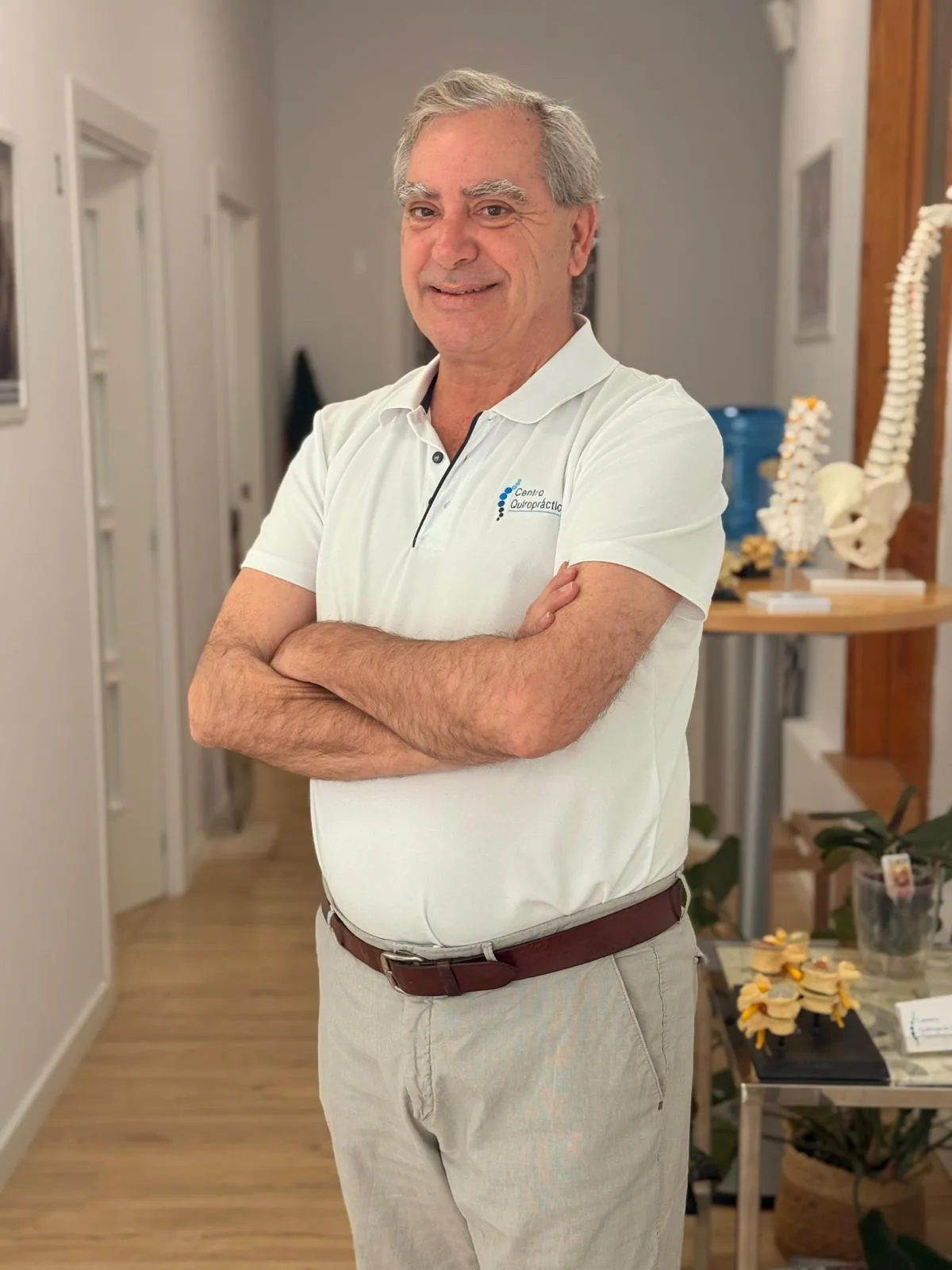
José María Puig Sobrino
Doctor of Chiropractic
When someone arrives at Centro Quiropráctico Puig in Estepona for the first time, they almost always ask the same question: “How do you work?” The short answer is: it depends on you. The long answer is this article.
There are chiropractors who work with a single technique and apply it to everyone. I’ve chosen a different path. With training in six different methods, I can adapt the care to what each patient needs at each moment: their age, their build, the type of problem, the area of the spine affected and how their body responds. On the Costa del Sol I see a wide range of profiles, from young athletes to older people who have lived with discomfort for years, and that variety calls for versatility.
Here are the six techniques that are part of my daily practice.
Gonstead Technique
Dr. Clarence Gonstead was an engineer before becoming a chiropractor. That training shows in his method: methodical, systematic, with no room for improvisation.
Gonstead is probably the most demanding technique in terms of analysis before the adjustment. Before making any correction I use five criteria: instrumentation (detection of thermal differences along the spine), static palpation, motion palpation, postural observation and, when needed, radiographic analysis. Only when I have a clear picture of which vertebra is restricted and in which direction, do I apply the adjustment.
The adjustment itself is high velocity and low amplitude. Precise. It isn’t about adjusting the whole spine “just in case”, but about working exactly where it’s needed.
It’s especially useful for cervical and spinal issues with well-localised dysfunctions, and for patients who respond well to a direct, specific approach.
Cox Flexion-Distraction
If Gonstead is surgical precision, Cox is gentle, sustained work. They are completely different philosophies and, for that reason, they complement each other well.
Developed by Dr. James Cox, this technique uses an articulated table that allows controlled movements of flexion, extension and lateral traction in specific segments of the spine. The patient lies face down and, through a gentle lever, I generate a decompression effect on the disc and joints in that area.
The effects are several: it increases intervertebral space, improves local circulation, favours disc nutrition and relaxes contracted muscles. No thrusts, no forced cracks. Many patients describe the session as a progressive relief they notice as it happens.
It’s the technique I choose for herniated and bulging discs, sciatica, spinal stenosis and chronic lower back pain that doesn’t respond well to conventional adjustments. It’s also my first option with older patients or those who are very sensitive to pain.
Thompson Drop Technique
Thompson introduces a different element: the drop table. Each section of the table has a mechanism that gives way slightly at the moment of the adjustment. That fraction of an inch of descent reduces the force I need to apply and makes the adjustment more tolerable and, at the same time, very effective.
One of the best-known applications is the correction of functional short leg (differences in the apparent length of the legs that come from pelvic misalignments, not from real anatomical differences). Thompson lets me assess and correct these misalignments with a lot of precision.
It’s a technique that works well in the pelvis, sacrum and lower back, and that tends to surprise those who try it for the first time: the drop mechanism makes it far gentler than it looks.
Diversified Technique
Diversified is the “base” technique of modern chiropractic. If you’ve received a chiropractic adjustment at some point in your life, it was probably Diversified or something very close to it.
It’s a high-velocity, low-amplitude manual adjustment, applicable to any segment of the spine. What makes it versatile isn’t a special mechanism, but the breadth of its applications: it works for the neck, upper back, lower back, ribs and peripheral joints. And the chiropractor can adjust the intensity, the angle and the speed according to the patient’s characteristics.
That crack many people associate with the chiropractic adjustment usually comes from here. It’s the release of gas inside the joint, a completely normal phenomenon called cavitation, and it doesn’t always happen, nor does it need to happen for the adjustment to be effective.
Activator Method
The Activator is a hand-held instrument that delivers a very fast and controlled mechanical impulse to the vertebral segment. No levers, no rotations, none of the sound of the manual adjustment. It’s the lowest-force method of all the ones I use.
Developed in the 1960s and widely researched ever since, the Activator has specific protocols to assess the spine and decide where to apply the impulses. The speed of the instrument, faster than the protective muscular reflex, allows it to act on the joint before the body “puts up its guard”.
It’s ideal for patients with osteoporosis or bone fragility, older people, children, post-surgical cases or any situation calling for an especially delicate approach. I also use it as a complement to other techniques when there are very sensitive or reactive areas.
SOT (Sacro Occipital Technique)
SOT works on the relationship between the sacrum (the base of the spine) and the occipital bone (the base of the skull). It starts from the idea that the central nervous system works better when that relationship is balanced, and that many spinal dysfunctions have their origin in pelvic imbalances.
Unlike the other techniques, SOT doesn’t depend on high-velocity adjustments. It uses wedges or blocks placed under the patient’s pelvis, drawing on the weight of the body itself and the breath to release tensions progressively. It’s a more subtle work, but it can have profound effects on posture and on the overall function of the spine.
In my practice in Estepona I often combine it with Gonstead or Diversified when I want to work both on the local structure of a vertebra and on the patient’s global postural pattern.
Why training in several techniques matters
There isn’t one technique that is better than all the others in absolute terms. Each has its indications, its limitations and its ideal cases. The value of mastering several is being able to choose the right tool for each person.
On the first visit to Centro Quiropráctico Puig I take the time to assess you in depth: your history, your posture, your mobility, how your spine responds. From that, I decide which combination makes most sense for you. Sometimes we use Gonstead on the neck and Cox on the lower back in the same session. Other times the Activator is what fits best. There is no single answer.
As a member of the Spanish Chiropractic Association (AEQ, #1036), I keep up ongoing training in all these techniques. The AEQ requires university-level standards and continuing education from its members, which ensures the level of care is aligned with the available evidence.
If you have questions about which technique might suit you, or you simply want to know how I can help, book your first visit. We see patients in Estepona and from across the Costa del Sol and the province of Málaga.
José María Puig Sobrino
Doctor of Chiropractic, Centro Quiropráctico Puig
Doctor of Chiropractic (D.C.) from Cleveland University Kansas City. AEQ member #1036. Specialist in SOT, Gonstead and Cox Flexion-Distraction. Over a decade looking after families in Estepona and the Costa del Sol.
Related articles
Chiropractic for athletes on the Costa del Sol
Surf, padel, golf, running, cycling or triathlon in Estepona and Marbella: how chiropractic care with Dr. Puig may improve performance and recovery.
ChiropracticChronic stress and neck tension: the connection
Why stress settles in your neck and shoulders, and how chiropractic care can help break the cycle. Dr. Puig, Estepona, Costa del Sol.