Chronic stress and neck tension: the connection
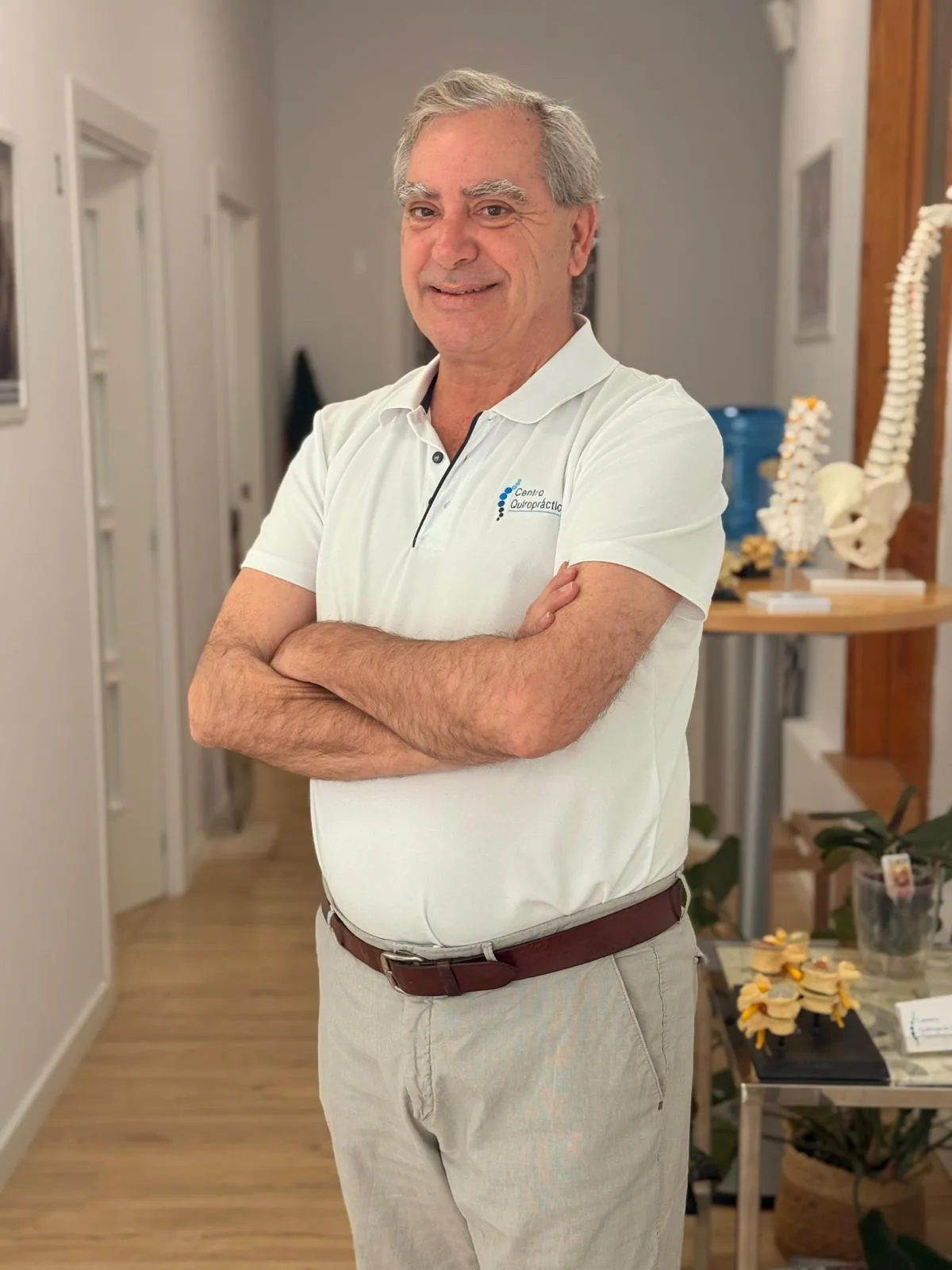
José María Puig Sobrino
Doctor of Chiropractic
“I’m here about my neck, but honestly, this past year the stress has been brutal.” If I had to pick the sentence I hear most often at my Estepona practice lately, that would be it. And it is no coincidence: stress is now the most common underlying reason people end up looking for a chiropractor, even when they arrive talking about muscle knots.
In this article I want to explain the link between sustained stress and that tension you feel in your neck, jaw and shoulders. And why tackling it with stretches alone usually falls short.
Your spine feels your stress before you do
When your brain perceives a threat (an email at eleven at night counts as a threat), it activates the sympathetic nervous system: the famous fight-or-flight mode. Your heart speeds up, your breathing gets shallow, and your muscles get ready for action. Especially the muscles that stabilise your head and neck: the trapezius, levator scapulae and the suboccipitals.
The mechanism itself is not the problem; it is healthy and has kept us alive as a species. The problem is that the eleven-at-night email arrives every single day. The system never switches off, and muscle activation designed to last minutes ends up lasting weeks. You know the result: shoulders like rocks, a stiff neck when you turn, headaches that start at the base of the skull, and that feeling of carrying weight even when your hands are empty.
Over time, that sustained tension alters the mechanics of the cervical vertebrae. Movement restrictions appear, what we call vertebral subluxations, which are associated with increased irritation of the nervous system. And here an uncomfortable loop closes: stress tightens the spine, and a tight spine sends constant alarm signals to the brain, which reads them as trouble and keeps the alarm mode on. Stress creates tension, tension creates more stress.
The three faces of stress (and no, they are not all mental)
In chiropractic we talk about three types of stress that affect your spine:
Physical stress. Sustained postures at the computer, hours in the car between Estepona and Marbella, sleeping on a mattress past its best, always carrying the children on the same side.
Chemical stress. Poor diet, too little water, too much caffeine or alcohol, smoking. Everything that inflames also tightens.
Emotional stress. Work, money worries, caring for relatives, grief. The one we underestimate most, and the one I see most clearly reflected in my patients’ necks.
All three converge in the same place: your nervous system. And your nervous system lives, quite literally, inside your spine.
What chiropractic can do (and what it cannot)
Let’s be clear first about what it does not do: a chiropractic adjustment will not remove your boss, your mortgage or your worries. Emotional stress needs its own tools, and if your situation feels overwhelming, a psychology professional is the right person to see.
What we can do is work on the physical side of that loop. When I adjust a spine that has been in alarm mode for months, I am after two things: restoring movement in the vertebrae that have become restricted, and reducing the nervous system irritation associated with those restrictions. Many patients describe a sense of “letting go” after the adjustment, as if the body finally lowered its guard. There is a physiological explanation: as joint function improves, the spine sends fewer alarm signals up to the brain.
At my Estepona practice I mostly use the SOT Technique for this type of patient. It works with blocks under the pelvis and with your breathing, without forceful manipulation, and it is particularly well suited when the nervous system is already overactivated. An aggressive approach in someone with chronic stress tends to backfire; a gentle, progressive one helps the body remember what relaxed feels like.
Signs your stress is already affecting your spine
- You clench or grind your teeth, especially at night
- Headaches that start at the base of the skull and climb towards the temples
- Shoulders permanently raised (check yourself in the mirror)
- A stiff neck on waking, even with a good mattress
- A knot between the shoulder blades that never quite goes
- Short, chesty breathing instead of belly breathing
If you recognise yourself in three or more, your body has been asking for attention for a while.
Small changes that help (alongside the adjustment)
Chiropractic care works best when you back it up. Nothing revolutionary, just things you can start today: two-minute breaks every hour at the computer, a walk along the seafront without your phone, belly breathing before sleep (four seconds in, six seconds out), and checking your screen height, which in most cases is too low.
Don’t normalise living tense
Wearing your shoulders as earrings is not your natural state, however used to it you have become. At Centro Quiropráctico Puig we assess how your spine is doing, explain what we find and design a care plan adapted to your case, with gentle techniques if that is exactly what your nervous system needs.
If stress has moved into your neck, book your first visit or call us on +34 952 791 996. We are in Estepona and look after patients from across the Costa del Sol.
José María Puig Sobrino
Doctor of Chiropractic, Centro Quiropráctico Puig
Doctor of Chiropractic (D.C.) from Cleveland University Kansas City. AEQ member #1036. Specialist in SOT, Gonstead and Cox Flexion-Distraction. Over a decade looking after families in Estepona and the Costa del Sol.
Related articles
6 chiropractic techniques: Gonstead, Cox, SOT and more
Gonstead, Cox Flexion-Distraction, Thompson, Diversified, Activator and SOT: the 6 techniques Dr. Puig (AEQ #1036) uses in Estepona.
ChiropracticChiropractic for athletes on the Costa del Sol
Surf, padel, golf, running, cycling or triathlon in Estepona and Marbella: how chiropractic care with Dr. Puig may improve performance and recovery.