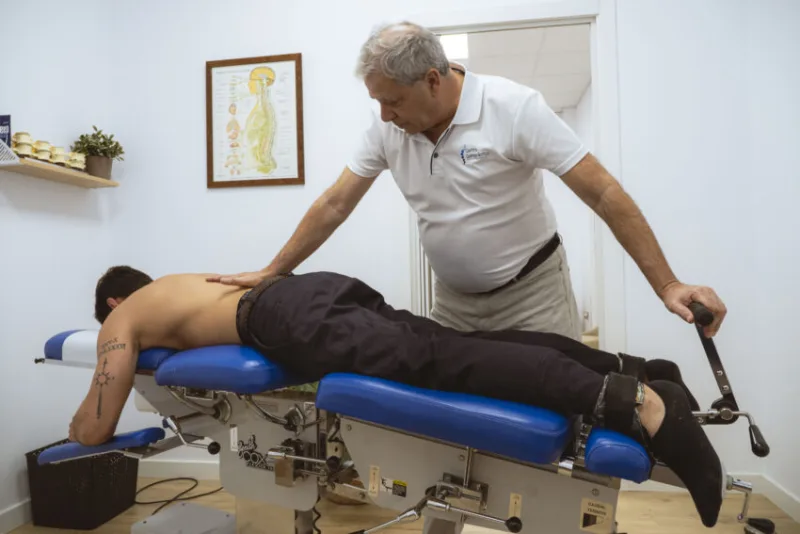
Dr. Puig works with 6 different chiropractic techniques. That allows him to adapt the adjustment to each person's age, sensitivity and preferences, from classic manual techniques to low-force techniques using blocks, special tables or an instrument.
SOT Technique (Sacro Occipital)
The Sacro Occipital Technique (SOT) focuses on the relationship between the sacrum and the occiput, the two ends of the spinal column. It uses positional blocks under the pelvis and gentle adjustments, making use of breathing and the body's own weight. It is widely used with expectant mothers, children and people who prefer a low-force approach. Dr. Puig is a certified SOT specialist.
Diversified Technique
The Diversified Technique is the most widely used in chiropractic worldwide. It involves manual high-velocity, low-amplitude (HVLA) adjustments applied to a specific spinal joint, with the aim of improving its mobility. It is the classic chiropractic adjustment, and Dr. Puig uses it at his Estepona centre when the assessment indicates it.
Gonstead Technique
The Gonstead Technique is one of the most complete systems of analysis and adjustment in chiropractic. It combines several assessment criteria: observation, static palpation, motion palpation, instrumentation and, where they already exist, imaging provided by the patient. With that information it locates the segment to be adjusted and uses the minimum force needed.
Thompson Technique
The Thompson Technique, also known as Terminal Point or Drop Table, uses a chiropractic table with sections that drop slightly as the adjustment is applied. That mechanism reduces the force needed and makes the adjustment more comfortable. It is useful for anyone who prefers a gentler adjustment, such as many older adults.
Cox Flexion-Distraction
The Cox Flexion-Distraction technique uses an articulated table that makes gentle, rhythmic flexion and traction movements of the lower back, with no thrust. It is a low-force technique that Dr. Puig often uses for the lumbar area, with older adults or with anyone who prefers to avoid the manual adjustment, always after a prior assessment and taking into account any medical reports you bring.
Activator Method
The Activator Method uses a precision mechanical instrument (the Activator Adjusting Instrument) that delivers a quick, controlled impulse to the vertebra. It is a low-force technique often used with people who prefer to avoid the manual adjustment, older adults and young children. The instrument allows precise control over the direction and force of the impulse. Dr. Puig is certified in the Activator Method.
Our care approach
At Centro Quiropráctico Puig we organise care in three phases, which we review with you as you respond:
- 1 Initial phase: The first few weeks, with sessions closer together while we see how your body responds to the adjustment. At the end of this phase we review with you how you are feeling and decide the next steps together.
- 2 Stabilisation phase: Sessions become more spaced out. We keep working on mobility and posture and give you simple advice for everyday life: breaks, movement and your workstation.
- 3 Maintenance phase: Periodic visits, if you choose, to check your spine and keep up what we have worked on. We agree the frequency based on your activity and preferences.
Why choose Quiropráctico Puig in Estepona?
- José María Puig Sobrino, Doctor of Chiropractic (D.C.), AEQ member no. 1036
- 4.9/5 on Google (126 reviews)
- Manual and instrument-assisted techniques tailored to each person, with informed consent at every step.
Frequently asked questions
After an assessment that includes a physical examination, postural analysis and mobility tests, Dr. Puig proposes the technique or combination of techniques he considers most suitable. The choice depends on your age, the area we are going to work on, your preferences and how comfortable you feel with each technique. If you would rather not receive manual adjustments, there are low-force alternatives.
There is no single best technique. If you have a herniated disc diagnosis, Dr. Puig first reviews your reports and assesses whether chiropractic care is appropriate in your case. When it is, he usually opts for low-force techniques such as Cox Flexion-Distraction, which mobilises the lower back without a thrust, and keeps in touch with your doctor.
They are a different way of delivering the adjustment, not a lesser version of it. Techniques such as SOT, Activator Method or Thompson use less force and do not produce the click of a manual adjustment, so many expectant mothers, children, older adults and sensitive patients find them more comfortable. Which one suits you is something we decide together after the assessment.
Discover our chiropractic centre in Estepona and find out how we can help with a personalised, professional approach.