What is a chiropractic adjustment? Complete guide
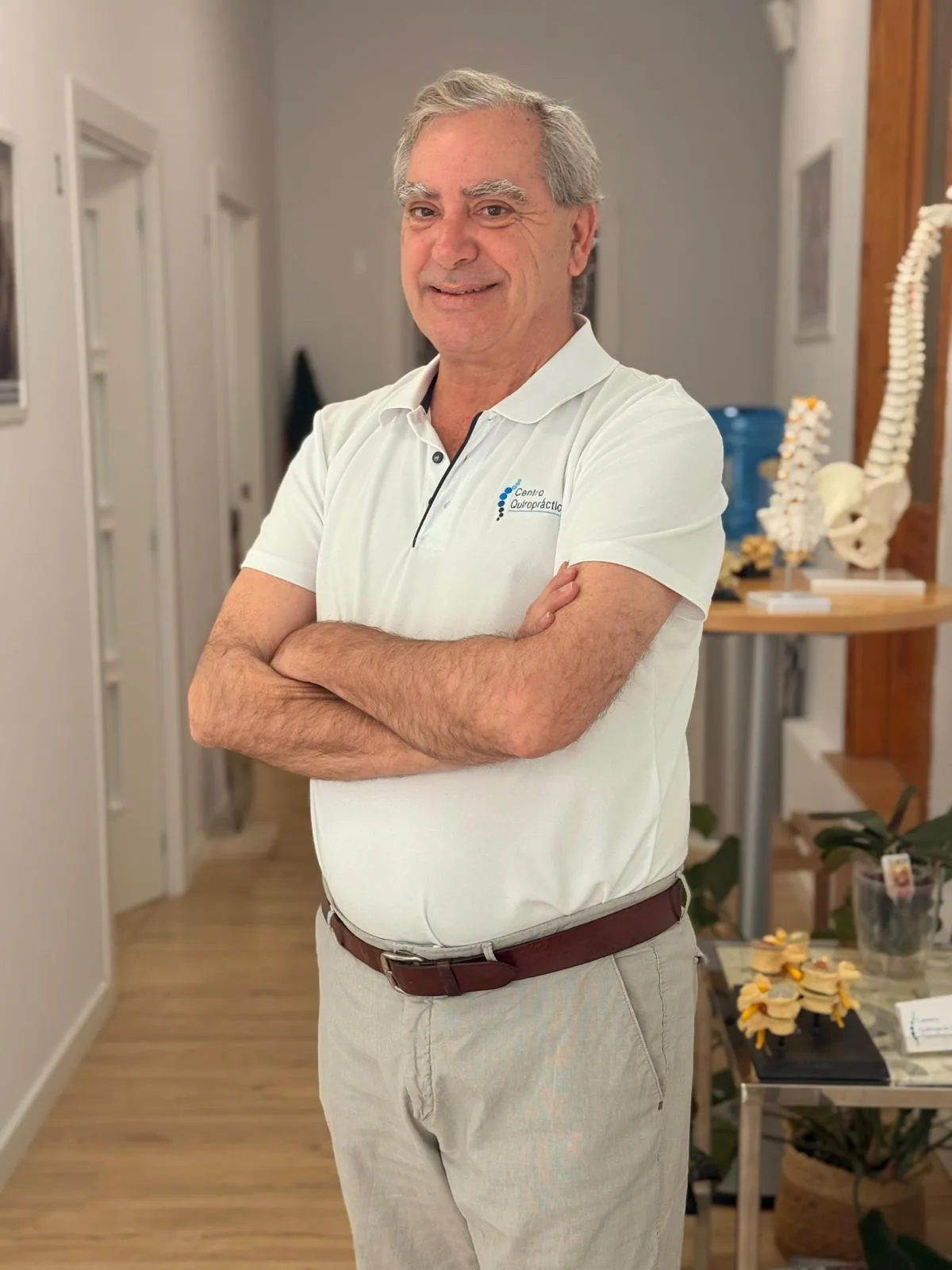
José María Puig Sobrino
Doctor of Chiropractic
“Is everything going to crack?” That’s the phrase I hear most often when someone comes to the centre for the first time. And I understand it completely. Social media videos, films and comments from people who have never set foot in a chiropractic practice paint a picture that has little to do with reality.
If you’re thinking of visiting a chiropractor in Estepona and don’t know what to expect, this article is for you. I’m going to explain exactly what an adjustment is, why that sound happens, and how a first visit at Centro Quiropráctico Puig goes.
What a chiropractic adjustment is
A chiropractic adjustment is a manual, precise and controlled movement applied to a joint (usually of the spine) to improve its mobility and its biomechanical function.
It is not a massage. It is not “putting bones back in place”. And it has nothing to do with brute force.
The underlying idea is straightforward: when a vertebra loses its normal range of motion or its correct alignment (what we call a vertebral subluxation in chiropractic), it can create interference in the nearby nerves. That shows up as pain, muscle tension, stiffness or reduced function. The adjustment works to correct that dysfunction so your body can recover its capacity to function properly.
Your nervous system coordinates every function in your body. When something interferes with that communication between brain and body, problems start to appear. The chiropractic adjustment works to remove that interference.
If you’d like to go deeper into the basics of chiropractic care, I have a full page on what chiropractic is where I explain everything in more detail.
The famous “crack”: what that sound actually is
Let’s tackle the question everyone asks. That sound some people love and others find a little off-putting.
It is not your bones breaking. Or your ligaments stretching. Or anything snapping “back into place”.
What happens is a phenomenon called cavitation. Inside your joints there is synovial fluid, a natural lubricant. When the adjustment slightly separates the joint surfaces, the pressure inside the joint capsule changes and small gas bubbles (mostly carbon dioxide and nitrogen) are released. That “pop” is simply gas being released. Nothing more.
It’s the same mechanism as when you crack your knuckles. And no, it does not cause arthritis or joint wear. That was disproved by scientific research decades ago.
Something important: the sound is not the goal of the adjustment. Sometimes it pops, sometimes it doesn’t. An adjustment can be perfectly effective without you hearing a thing. At Centro Quiropráctico Puig we use different techniques depending on the case: Gonstead, SOT, Cox Flexion-Distraction, Thompson, Activator Method, Diversified. Some involve a quick thrust that may produce that “pop”; others, like the Activator or Cox, are so gentle you barely feel them. I don’t choose the technique based on my preferences but on what your spine actually needs.
Your first visit at Centro Quiropráctico Puig: step by step
This is what is going to happen when you come and see us. No surprises.
Full case history. The first thing is to listen to you. I want to know what’s going on, since when, what makes it better and what makes it worse. Also your health history, level of physical activity, type of work, whether you play any sport on the Costa del Sol. It all matters. I take the time I need because I don’t believe in generic solutions.
Chiropractic assessment. Then I carry out a full functional assessment: mobility tests, palpation of the spine, neurological and orthopaedic tests. I need to understand how your body moves, where there are restrictions, and how your nervous system is responding. This is the phase that makes the difference between a generic adjustment and a truly specific one.
Explanation before any adjustment. Before doing any adjustment, I explain exactly what I’ve found, what it means and what care plan I propose. If you don’t understand what’s going on, you can’t make an informed decision. Your trust is the foundation of everything we do here.
The first adjustment. If everything is clear and you’re happy to go ahead, we proceed. It’s specific, quick and much gentler than you expect. Most people are surprised at how little it bothers them (usually not at all) and at how well they feel walking out the door.
The first visit lasts between 45 minutes and an hour. Follow-up visits are shorter, usually 15 to 20 minutes.
Who is the chiropractic adjustment for?
A lot of people think the chiropractor is only for back pain. And yes, it’s one of the most common reasons people come to the centre in Estepona. But the chiropractic adjustment can help with many more situations.
We see people of all ages and backgrounds. Athletes on the Costa del Sol who want to improve their performance or recover sooner from an injury. People with sedentary jobs who build up neck tension at the computer. People who simply want to look after themselves proactively. Residents of Estepona, Marbella, San Pedro and Manilva who can’t easily find this kind of care nearby.
You don’t need to be in pain to benefit from an adjustment. In fact, many of our most consistent patients come precisely because they no longer have pain and they want to keep it that way.
You can have a look at all the profiles of people we work with to see if your situation fits.
Why it matters who adjusts you
This isn’t said often enough: not everyone who offers “chiropractic” has the training needed to do it safely and effectively.
A properly trained chiropractor completes five or six years of university studies dedicated exclusively to chiropractic, accredited by the European Council on Chiropractic Education. That includes anatomy, physiology, neurology, adjustment techniques, differential assessment and supervised clinical practice. It is not a weekend course.
I’m an active member of the Spanish Chiropractic Association (AEQ) with registration number 1036. The AEQ only accepts chiropractors with accredited university-level training. Founded in 1986 and with more than 430 members across Spain, it is your guarantee that you’re in the hands of someone properly qualified.
When you choose a chiropractor, in Estepona or anywhere else, always ask about their training and whether they belong to the AEQ. It’s the minimum you should expect.
Take the first step
If you’ve been struggling for a while, if someone has recommended you give chiropractic a try, or you’re simply curious, the first step is to come in and have a chat.
Centro Quiropráctico Puig is in Estepona, right in the heart of the Costa del Sol, and we see people from all over the province of Málaga. The first thing we’ll do is listen to you.
Book your first appointment here or send me a message on WhatsApp. I’ll be happy to answer any questions before you come.
José María Puig Sobrino
Doctor of Chiropractic, Centro Quiropráctico Puig
Doctor of Chiropractic (D.C.) from Cleveland University Kansas City. AEQ member #1036. Specialist in SOT, Gonstead and Cox Flexion-Distraction. Over a decade looking after families in Estepona and the Costa del Sol.
Related articles
6 chiropractic techniques: Gonstead, Cox, SOT and more
Gonstead, Cox Flexion-Distraction, Thompson, Diversified, Activator and SOT: the 6 techniques Dr. Puig (AEQ #1036) uses in Estepona.
ChiropracticChiropractic for athletes on the Costa del Sol
Surf, padel, golf, running, cycling or triathlon in Estepona and Marbella: how chiropractic care with Dr. Puig may improve performance and recovery.